English
 French
 Spanish
The new version of IFS Food Version 8 was published recently by the International Featured Standard (IFS) with the purpose of reflecting recent advancements in the market and ensuring IFS Food customers get the most out of their certification.
Simultaneously, the announcement of IFS Global Markets Food Version 3 means that food industries now have access to an updated development program that helps food suppliers gradually build product safety and quality processes and set the path toward IFS Certification.
IFS is a globally recognized certification system that establishes product safety and quality standards and programs for companies in the food and consumer goods supply chain. It provides tools and services to retailers and brand owners with the goal of incorporating best practices, conducting appropriate risk assessments, and driving a product safety and quality culture throughout their organizations.
Food enterprises worldwide that have adopted IFS certification must now gear up and lay the groundwork to comply with the latest updates and requirements.
A Guide on IFS Food Version 8
IFS Food Version 8 assesses the capacity of a food producer to manufacture products that meet legal obligations and customer specifications while ensuring safety, authenticity, and quality.
This version introduces higher standards to conform with the benchmark criteria outlined by the Global Food Safety Initiative (GFSI 2020) and other authoritative institutions such as the Codex Alimentarius Commission (CAC) and the International Organization for Standardization (ISO), strengthening overall food safety practices.
Let’s look at the key highlights of IFS Food Version 8 that stakeholders need to familiarize themselves with to ensure compliance.
Compliance Date
IFS Food Version 8 was published in April 2023, and audits are possible starting October 1, 2023. Certification under Version 8 becomes mandatory for all certified companies beginning January 1, 2024.
Major Agendas
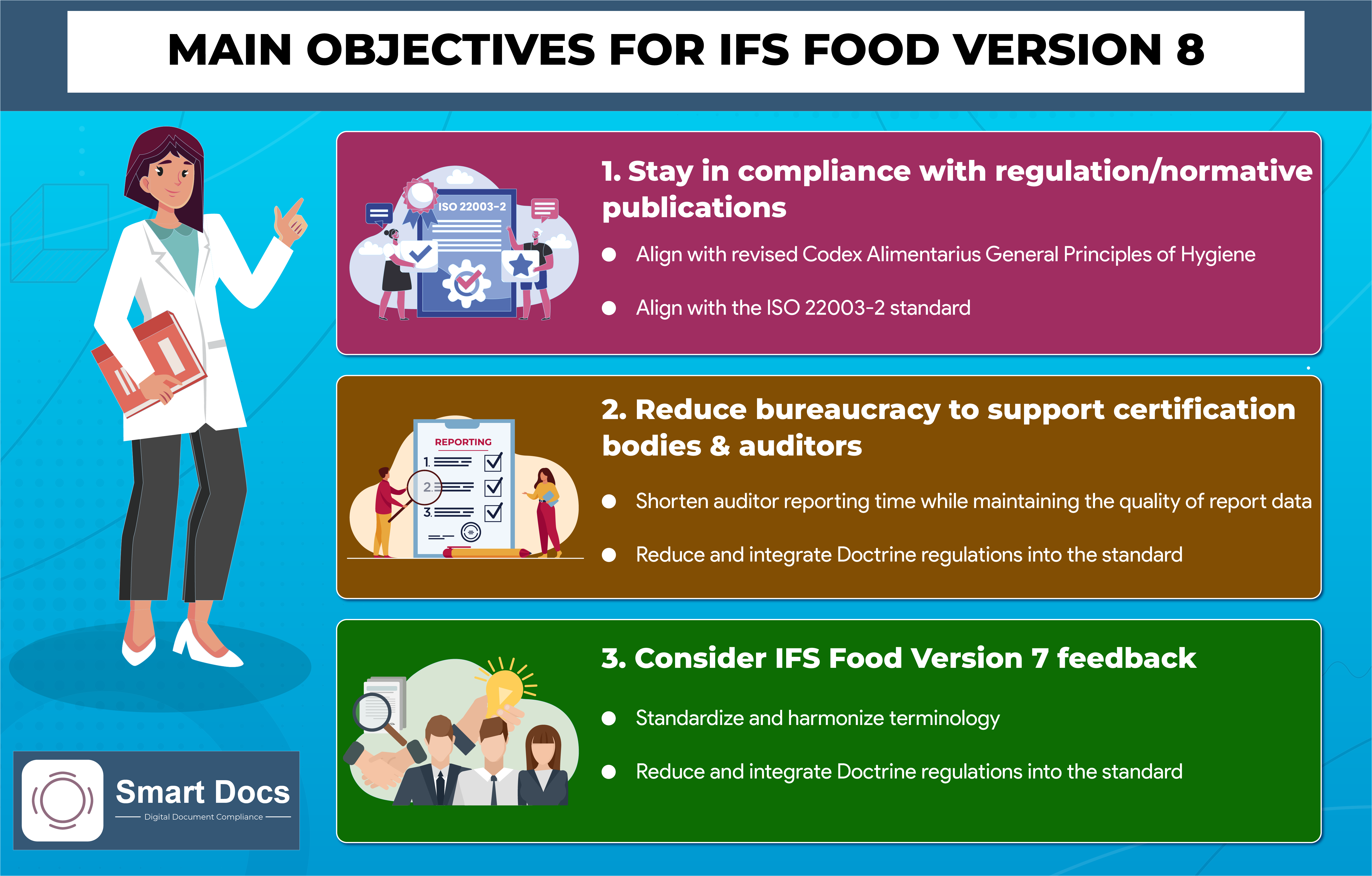
- Align with the most recent revision of the Codex Alimentarius General Principles of Hygiene
- Align with the ISO 22003-2 standard
- Decrease the reporting time for auditors while maintaining the same level of quality in report information
- Reduce Doctrine Rules and integrate them into the standard
- Harmonize terminology across the standard
- Incorporate stakeholder feedback from IFS Food Version 7
Summary of Important Changes
Classifying B-Score as a Deviation
The B score is now a deviation for regular and knockout requirements
The IFS scoring system is based on three fundamental principles: continuous improvement, uniformity, and a gradient rating system of A, B, C, and D. Each IFS requirement is assigned a score based on compliance levels.
A score of A indicates full compliance. A B score signifies a minor deviation with nearly full compliance. A C score represents a deviation where only part of the requirement is implemented, while a D score indicates a deviation when none of the requirements are implemented.
This scoring system provides clear feedback to audited companies and their customers, highlights areas for improvement, and fosters a culture of continuous enhancement while supporting the achievement of higher compliance scores.
Unannounced Audits Rule
The IFS Star Status Indicates an Unannounced Audit
The inclusion of unannounced audits maximizes the credibility of the auditing process, as it demonstrates that the company consistently adheres to IFS requirements on a daily basis. This status reassures that the audit was conducted without prior notification, showcasing the company’s commitment to maintaining the highest safety standards in its production. A star symbol is recorded in both the IFS database and on the IFS certificate, and a dedicated logo is also used to be visible to partners.
Claims on IFS Certificate Scope
It is possible to add EU PDO (Protected Designation of Origin) or PGI (Protected Geographical Indication) on the IFS Certificate with a disclaimer.
This means that a food producer can include the EU PDO or PGI label on their IFS certificate, indicating that their product is made in a specific geographical area and has unique characteristics associated with that area. The disclaimer must be added to the certificate to indicate that the IFS certification does not cover the PDO or PGI aspects of the product.
Objectives for Food Safety Culture
Companies must define objectives for each of the four dimensions of food safety culture.
According to IFS standards, certified companies must set targets for each of the four dimensions of food safety culture, which are:
- Communication on company policy and food safety responsibilities
- Training
- Employee feedback on food safety issues
- Performance measurement
This ensures that all levels of management, from senior to supervisory, are responsible for clearly communicating the company’s mission and food safety policies to workers to promote a strong food safety culture within their organization.
Reporting Time, Doctrine Rules & Administrative Requirements
The reporting time, the number of doctrine rules, and other administrative requirements are reduced while still in line with GFSI documentation requirements and accreditation.
Version 8 has streamlined and simplified certain administrative processes along with four new checklist requirements for audits while improving the reporting time to help companies save time and resources efficiently. However, it is equally important for companies to ensure that they are still meeting the documentation requirements of GFSI benchmarking and accreditation, as these are crucial for maintaining the integrity of IFS certification.
Checklist Changes for Audit Effectiveness
The restructured checklist follows the audit process more consequently and increases the audit’s efficiency.
The version 8 checklists are designed to make the audit comprehensive and accurate such that auditors can evaluate the compliance of businesses with respect to various aspects such as corporate policies, management commitment, food safety and quality risks, and employee hygiene practices and training. The checklist is now lessened from 6 chapters to 5 as food defense is added to chapter 4. The wording in the checklist is now more consistent and clear to clarify the intention of requirements better. The IFS provides a comparison for version 7 and 8 checklists, and the document lists the changes for each provision, which gives companies a quick and easy overview and helps them prepare for their first version 8 audit.
Agreement with Codex Alimentarius, ISO 22003-2 and GFSI Mandates
The standard was aligned with Codex Alimentarius, ISO 22003-2, and GFSI benchmarking requirements.
Many of the modifications presented in version 8 integrate better conformance to these global standards. For instance, the term ‘assessment’ is now ‘audit’ and is defined based on ISO 22003-2 as a combination of various evaluation activities, including inspection, testing, and the management system, and it is now necessary that one out of every three inspections be unaware as per the GFSI rule.
Knockout Requirements
There are some minor wording updates in 6 of the knockout requirements.
The IFS has 10 “knockout criteria” or “KO requirements” that are used to determine certification eligibility. These changes are elaborated as follows:
The word ‘applied’ now reads documented, implemented, and maintained.
- Knockouts 4 and 5 have switched orders.
- Knockout 4 has the addition of testing and monitoring plans.
- Knockout 7 includes the clarification of the type of packaging.
- Knockout 8 necessitates the internal audit frequency to be within every 12 months.
- Knockout 9 includes a broader list of minimum topics to be included in the withdrawals, recalls, and incidence procedure.
Comprehending IFS Global Markets Food Version 3
IFS Global Markets Food acts as a roadmap for food industries, designed to provide an easy entry point to ensure sufficient food safety and quality practices by helping them systematically develop relevant systems to comply with legal regulations and customer expectations, ultimately leading to IFS Food Certification. By emphasizing the specific areas crucial to each company’s distinctive processes and employing a risk-based, product, and process-oriented approach, the program allows for the determination of implementation methods that suit the firm’s unique conditions and pushes continuous improvement. Since a team of international experts devised the original Global Markets catalogue of requirements, many food trade partners accept the program as a starting point for approving their suppliers.
Here is a brief overview of how the IFS Global Markets Food program guides food establishments seeking support to get IFS certified:
- The IFS Academy provides a training course for the stakeholders to learn about the structure of the IFS Food Program, including basic and intermediate levels. The basic level covers 45% of the IFS Food Standard requirements, while the Intermediate level encompasses 70%.
- The basic and intermediate levels each contain requirements regarding Food Safety Management Systems (FSMS), Good Manufacturing Practices (GMP), and control of food hazards. Each level is expected to take one year to complete.
- Meeting requirements that cover personal hygiene, waste management, cleaning and disinfection, and traceability, within a defined timeline will enable stakeholders to set up an adequate FSMS in their enterprises.
- Once the stakeholders implement the requirements in their industries, a preliminary assessment will be conducted by an accessor sent from a chosen certification body to identify and resolve compliance gaps.
- Stakeholders can then undergo full IFS certification. With the assistance of IFS Global Markets, food industries should be able to achieve 100% IFS Food Certification within three years.
- Once the stakeholders pass the certification, they receive extensive assessment reports highlighting potential improvements in their businesses, including a corrective action plan to achieve these goals. They are also added to the IFS database.
The new IFS Global Markets Food version 3 aligns with the IFS Product and Process Approach, enhancing its role as a precursor to IFS Certification. Version 3 illustrates the capability of different types of food establishments to attain IFS Certification. The improvements made in this version of the development program comprise changes to various prerequisites for developing product safety and quality processes that aim to make reaching this goal more accessible and efficient. It also offers globally assessed companies a diverse array of free guidelines and supportive tools to bolster their safety and quality management continuously.
Compliance Date
The new version 3 was published in January 2023, with assessments to the new version possible from July 1, 2023, and become mandatory from 1st October 2023.
Major Agendas
Version 3 came into being after version 2 was reviewed and updated to upgrade various elements and meet market trends and compliance regulations with the following objectives:
- Include various types of food suppliers and markets
- Strengthen and enhance the program
- Facilitate the path to IFS certification with an enhanced structure
- Update elements and add new features
Summary of Important Changes
IFS Orientation
In version 3, the structure and requirements of the program are in line with the IFS Food Standard, IFS Product and Process Approach, the assessment trail, the new Codex Alimentarius, and the latest regulations. Also, the risk-based approach is better represented.
Clarification of Requirements
The requirements are clarified in the guidance aligned with evolving market patterns. Version 3 presents 15 new requirements, which are essential for complying with legal and customer expectations and essential fundamental topics. It also complements the elementary food safety and quality management processes.
Revision of Wording and Overall Program Structure
The wording used in the program is made clear and explicit, making it easier for everyone to understand and follow. To simplify the implementation and monitoring process, the guideline is now integrated into the checklist.
Review of Requirement Levels
The consistency of requirement levels is improved as the consistency is steered to each requirement’s purpose and its corresponding level. Some requirements are split to fit individual needs better, accommodating a more customized plan to meet the standards.
Upgrade of Assessments
The assessment protocols and their related elements are refined, and there are new options available for follow-up assessments, extension assessments, and voluntary unannounced assessments. This gives businesses more flexibility in scheduling assessments and guaranteeing ongoing compliance.
Updated & Standardized Reporting
The updated report format delivers a clear and concise presentation of assessment results. This becomes useful for stakeholders to quickly understand the outcomes and identify areas for improvement and facilitates smoother assessments.
How Smart Docs Pave the Way for Food Industries to Comply With IFS Requirements Effortlessly
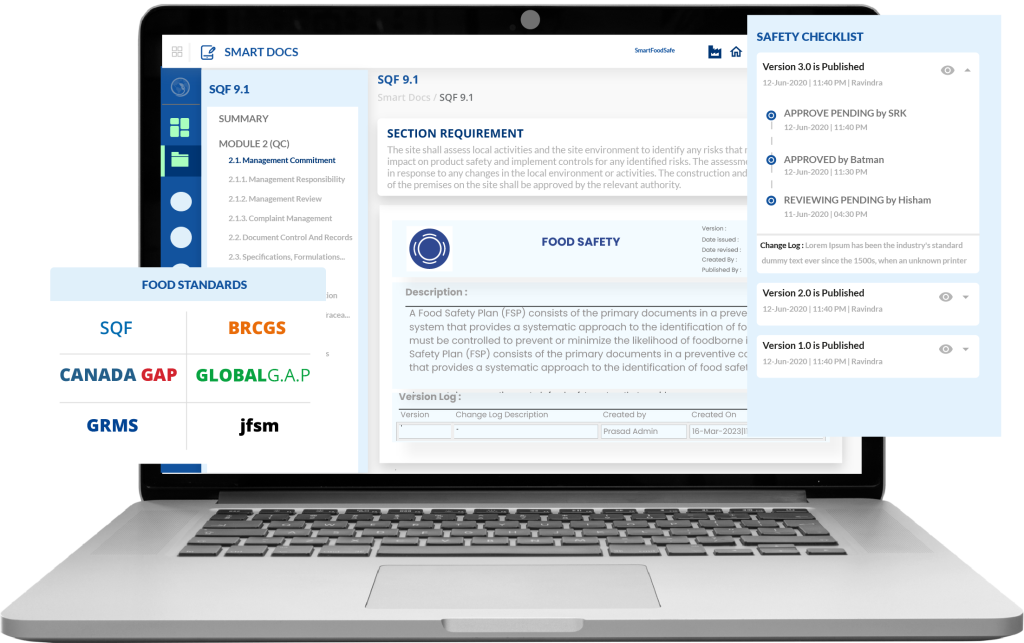
Smart Docs is a global quality and food safety document management system created by Smart Food Safe to help navigate food industries through the tiresome procedures for asserting compliance with Global Quality and Food Safety requirements through its suite of powerful features. By presenting centralized document control, task management, scheduling, notifications, and workflow capabilities, Smart Docs ensures optimized and organized handling of compliance-related tasks. Stay compliant with the IFS Food 8 updates with a one-click migration from IFS Food Version 7 to IFS Food Version 8 with Smart Doc’s standard migration feature.
Eliminating the need for traditional binders, it offers a digital, centralized repository for easy searching and access to documents, complete with a time-stamped audit trail in alignment with 21 CFR Part 11 Document Compliance. Not to mention, the Smart Linking feature enables users to connect policies, procedures, and records to relevant references and modules with just a single click. In this way, Smart Docs significantly unravel and expedite IFS compliance, empowering food businesses around the globe to meet regulatory standards effortlessly and transform their safety and quality systems digitally.